Rewriting the History of Two West African Kingdoms
Faculty Publication Feature Series
New Research. New Ideas. Conversations with Northwestern Qatar Scholars
The Faculty Publication Feature Series showcases significant new scholarship by Northwestern University in Qatar faculty, including books, journals, edited collections, monographs, and creative works. Through conversations with NU-Q scholars, we explore the ideas that drive their research, the insights they uncover, and the ways their work advances understanding of the complex issues shaping our world, particularly in the Global South.
--
For more than a century, historians have relied on two Arabic chronicles as foundational sources for understanding the history of medieval West Africa. Yet one of those texts, long accepted as authentic, had undergone significant nineteenth-century revisions that reshaped how generations of scholars understood the region's past.
In The Chronicles of Two West African Kingdoms: The Tārīkh Ibn al-Mukhtār of the Songhay Empire and the Tārīkh al-Fattāsh of the Caliphate of Ḥamdallāhi , Zachary Wright and his co-author present the original seventeenth-century chronicle alongside the later edited version, offering a new reading of West African history from the fifteenth through the nineteenth centuries.
Drawing on Arabic manuscripts from Timbuktu and other collections, the book combines newly edited Arabic texts, English translations, and extensive historical analysis. In doing so, it revisits longstanding assumptions about political authority, Islamic scholarship, enslavement, and historical writing across some of West Africa's most influential empires.
As part of Northwestern University in Qatar's Faculty Publication Feature Series, we spoke with Wright about the discoveries behind the book, the challenges of working with centuries-old manuscripts, and why these chronicles continue to matter today.
Q : What first drew you to these particular manuscripts, and how did you encounter the Tārīkh Ibn al-Mukhtār and Tārīkh al-Fattāsh in your research?
A: There are two principal Arabic chronicles of the Songhay Empire in West Africa: ʿAbd al-Raḥmān al-Sāʿdī's Tārīkh al-Sūdān and the work long known as the Tārīkh al-Fattāsh , traditionally attributed to Maḥmūd al-Kaʿti. Since their publication and French translation in the early twentieth century, these texts have served as foundational sources for the history of pre-modern West Africa. They document not only the Songhay Empire, but also earlier kingdoms including Ghana and Mali, tracing urbanization along the Niger River from at least the eighth century.
Yet anyone who studied the Tārīkh al-Fattāsh sensed inconsistencies in both its authorship and its narrative.
Our work restores the original chronicle of the seventeenth-century scholar Ibn al-Mukhtār al-Qunbili, whose text had effectively disappeared beneath nineteenth-century interpolations that later became known as the Tārīkh al-Fattāsh .
The analytical chapters in our book seek to correct more than a century of historical interpretation that relied on the altered text rather than the original manuscript.
Q: You work closely with Arabic manuscripts from West Africa. What was it like engaging with these sources? Were there moments that felt especially revealing?
A: Working with the Tārīkh Ibn al-Mukhtār was both rewarding and extraordinarily challenging.
The manuscript contains numerous Soninke, Mande, Songhay, medieval Moroccan Arabic, and even Spanish colloquialisms transliterated into Arabic, making close linguistic analysis essential.
One particularly revealing discovery concerned discussions of enslavement.
The original Arabic text showed that many of the explicit connections between enslavement and race or ethnicity were introduced through nineteenth-century interpolations rather than appearing in the seventeenth-century manuscript itself.
Enslavement certainly existed in medieval West Africa, in both Muslim and non-Muslim societies, but the institution evolved significantly over time. Recovering the original text allows us to understand those historical changes with much greater precision.
Q: Your book offers a new reading of West African history from the fifteenth to the nineteenth centuries. What changes when we view these chronicles through their original context?
A: The original Tārīkh Ibn al-Mukhtār demonstrates that the Muslim scholarly class (ʿulamāʾ) understood itself as an independent source of authority within the powerful empires of the period.
The nineteenth-century redaction that became the Tārīkh al-Fattāsh removed many passages emphasizing clerical independence, almost certainly reflecting the political ambitions of the Caliphate of Ḥamdallāhi and its efforts to marginalize scholars who did not support the state.
Our research reveals a long tradition of Muslim scholarly independence that stretches from the Songhay Empire through the era of the jihads, the trans-Atlantic slave trade, and into the period of colonial occupation.
Rather than viewing these scholars simply as supporters of political authority, the original chronicle presents them as active participants in shaping—and at times challenging—the political order.
Q: What do you hope students and fellow researchers gain from having access to both the Arabic editions and the English translations of these chronicles?
A: We hope readers come away with a deeper appreciation for the importance of historical writing in pre-modern West Africa and for the ways texts continue to shape identity across different historical moments.
Texts are living documents. They acquire new meanings as they are copied, edited, interpreted, and deployed by later generations.
By presenting both the Arabic editions and carefully prepared English translations, we hope students and researchers will spend time engaging directly with these remarkable sources and perhaps discover insights we ourselves overlooked.
We also hope readers engage with the analytical essays that accompany the texts, where we place these chronicles within the broader historical record through comparison with other written sources, oral traditions, and the archaeological evidence of the Middle Niger.
About the Book
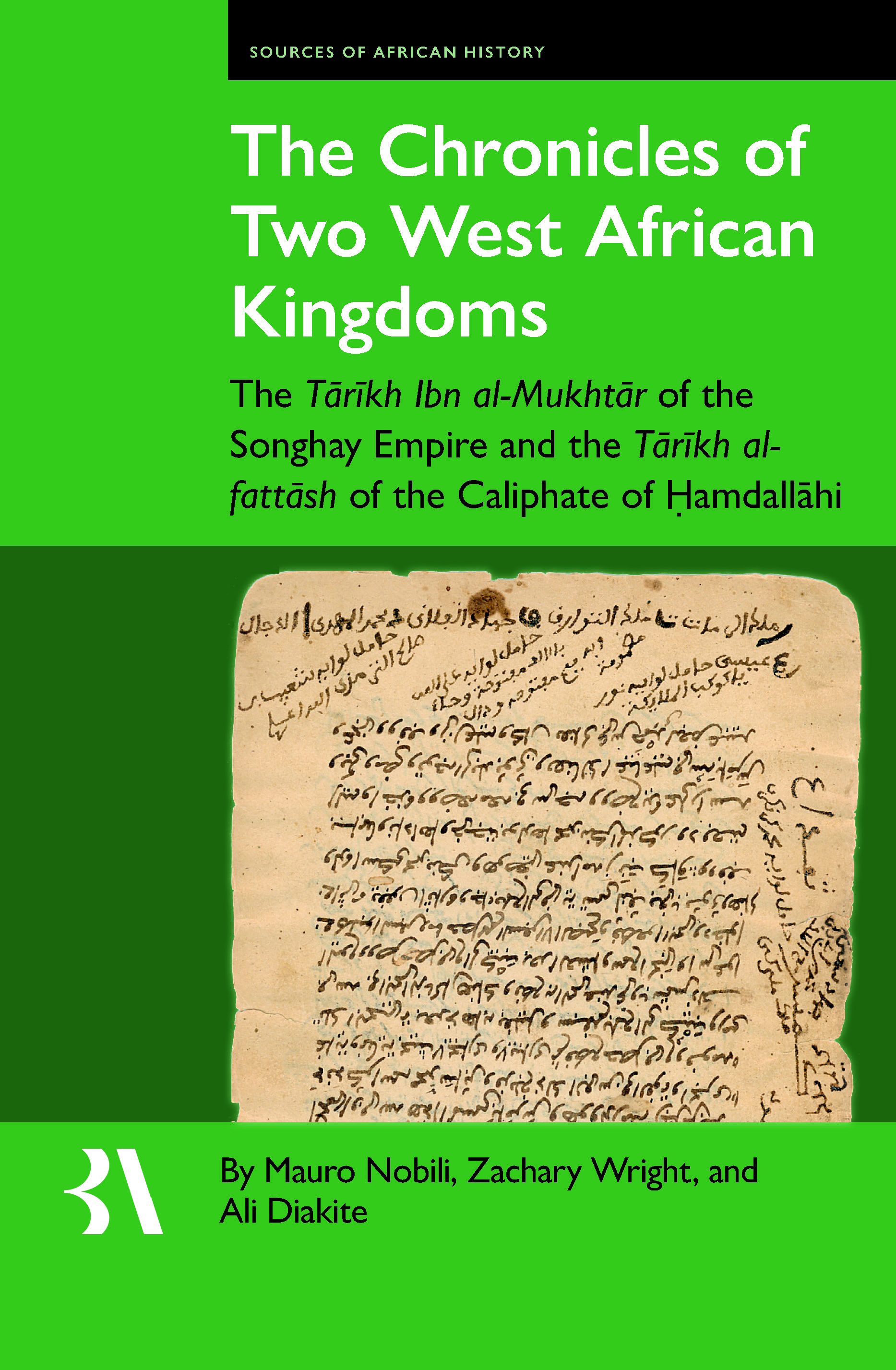
The Chronicles of Two West African Kingdoms: The Tārīkh Ibn al-Mukhtār of the Songhay Empire and the Tārīkh al-Fattāsh of the Caliphate of Ḥamdallāhi presents a new reading of West African history from the fifteenth to the nineteenth centuries. Drawing on Arabic manuscripts from Timbuktu and other collections, the volume presents newly edited Arabic texts and English translations of the long-obscured Tārīkh Ibn al-Mukhtār alongside the later work known as the Tārīkh al-Fattāsh . Through these sources, the book offers new perspectives on political authority, Islamic scholarship, and historical writing in pre-modern West Africa, while highlighting the central role Muslim scholars played in shaping the historical record.
About the Author

Zachary Wright is Associate Dean for Faculty Affairs and Professor in Residence at Northwestern University in Qatar. His research focuses on the intellectual, religious, and political history of Africa and the Islamic world, with particular expertise in Arabic manuscript traditions, Sufism, and the history of West Africa.


