A deeper, more dynamic presence at Web Summit Qatar 2026, showcasing the breadth of community excellence and expertise
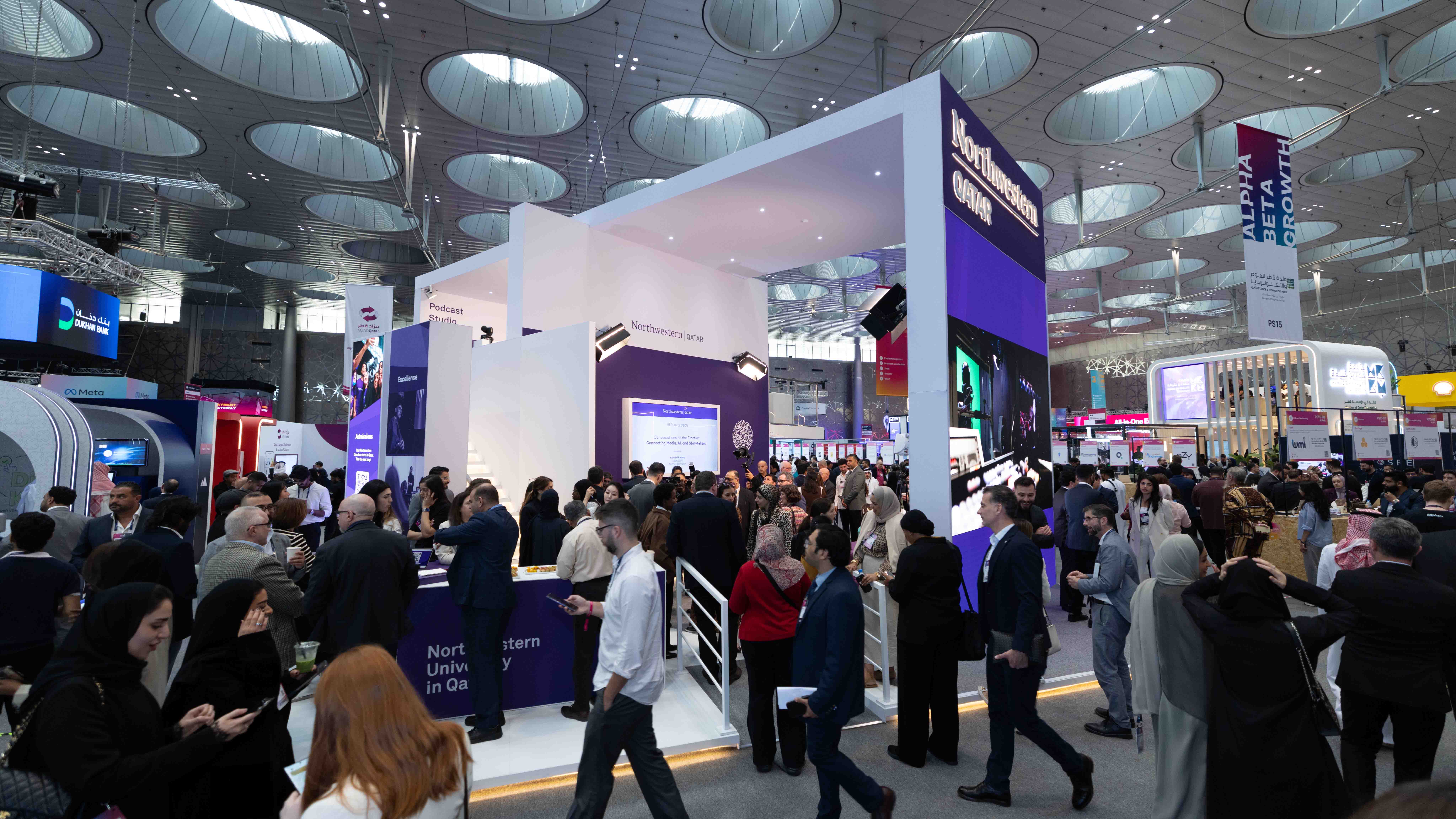
Marking its third consecutive year at the Summit, the University brought together research, teaching, and creative practice through a larger pavilion and broader programming, creating multiple points of engagement with its academic programs and strategic initiatives, inlcuding the Institute for Advanced Study in the Global South (#IAS_NUQ) and the artificial Intellegence and Media (AIM) Lab to the Media Majlis Museum.
“Being at Web Summit Qatar gives us a chance to share the excellent work we do across the campus,” said Marwan M. Kraidy, dean and CEO of Northwestern Qatar. “It’s not just faculty research or student projects; it’s the full range of expertise we cultivate here. Being able to show how our work connects media, communication, and technology in real ways to the broader world is what makes this presence meaningful.”
At the forefront of this year’s Web Summit presence was the WSQ Committee, chaired by Assistant Dean for Communication and Public Affairs Nisar Keshvani, which brought together faculty, students, and staff from across academic and research programs. "Our goal was to expand both the scale and the depth of engagement, offering participants multiple ways to engage with the work of NU-Q and connect with our faculty and students,” noted Keshvani.
“Being at Web Summit Qatar gives us a chance to share the excellent work we do across the campus. It’s not just faculty research or student projects; it’s the full range of expertise we cultivate here. Being able to show how our work connects media, communication, and technology in real ways to the broader world is what makes this presence meaningful”
Located at #E428, the pavilion spanned 14 by 10.5 meters, expanding from last year’s 12 by 9 meters. Its 360-degree entry points welcomed visitors from every direction, while digital screens displayed content from the student-led film club Studio 20Q, #IAS_NUQ student projects, and faculty trailers. Graphical totems emphasized the University’s core values, and the open layout encouraged interaction, connecting visitors directly with faculty, students, and the ideas shaping community work.
“We reimagined the pavilion as a two-story hub, with a dedicated stage for presentations and a podcast studio, while keeping the environment open and inviting. We wanted to create a place where dialogue, collaboration, and real-time learning could happen naturally,” said Keshvani. “Our aim was to create a space that sparks conversation, encourages exploration, and lets people experience our work firsthand,” he added.
Within this redesigned space, programming was anchored around four pathways, each offering a unique mode of engagement. “The four pathways allowed us to showcase our community’s work from multiple angles,” said Clovis Bergère, director of #IAS_NUQ and member of the Organizing Committee. “Dialogues of Impact brought global thinkers into conversation with NU-Q leadership; Learning in Motion translated academic insight into fast, practical sessions; the Innovation & Immersion Hub offered demonstrations and exhibition experiences; and the Podcast Studio & Live Conversations extended the dialogue beyond the pavilion.”
Across these pathways, the expanded pavilion hosted nearly 60 presentations and podcast sessions, two live demos, a high-level networking gathering, and special programming, engaging more than 50 presenters and speakers and giving visitors the platform to engage directly with faculty, students, and research initiatives.
Twenty minutes to insight
The main stage held 25 sessions under the theme "Learning in Motion." The twenty-minute micro-classes and presentations were led by faculty, students, and alumni, translating academic research into practical, real-world applications. "These sessions gave participants the opportunity to engage with the content directly, applying academic concepts to tangible scenarios, which enhanced understanding and connection,” said Bergère.
Conversations in real time and beyond
On the upper deck, the Podcast Studio hosted 28 live and recorded episodes featuring faculty, visiting speakers, and industry professionals. "The studio allowed for both real-time engagement and post-event distribution, extending the reach of our discussions on media, technology, and AI," noted Rami Al-Badry, director of production and digital media and member of the Organizing Committee. “Attendees could watch content creation in action, interact with hosts, and engage in multimedia storytelling, providing a richer experience than a traditional stage or lecture setting.”
Experiencing media futures
The pavilion also featured an experiential corner powered by the Media Majlis Museum, showcasing “Media Futures: Memes, Machines & New Realities.” This immersive exhibition invited visitors to engage with the ways media, technology, and storytelling, from memes and algorithms to AI-generated content, are shaping culture, public discourse, and imagined futures.
Alongside the exhibition, the Museum hosted hands-on workshops and interactive experiences that prompted visitors to explore and reflect on the intersections of creativity, research, and emerging technologies. “This off-site exhibition reflected NU-Q’s commitment to research-led cultural practice, showing how scholarly inquiry and creative experimentation can come together to examine the social and ethical implications of emerging media and technologies,” said Alfredo Cramerotti, director of the Media Majlis Museum.
Expanding connections with students and professionals
On the ground floor, the pavilion also functioned as a hub for direct engagement with six University departments: Admissions, #IAS_NUQ, the AIM Lab, Media Majlis Museum, Executive Education, and the Dean’s Office.
Prospective students connected with Admissions representatives to learn about programs and requirements, while professionals explored open-enrollment courses, masterclasses, and tailored training solutions. “We designed the space so that every visitor, whether a prospective student or a professional participant, could engage meaningfully with us, exploring programs and initiatives that align with their interests and goals,” said Alex Schultes, assistant dean for the student experience and member of the Organizing Committee.
Also as part of this year’s programming, Dean Kraidy hosted His Excellency Sheikh Jassim bin Mansour bin Jabor Al Thani, director of the Government Communication Office and chairman of the Permanent Web Summit Organising Committee, in a special Dean’s Global Forum. The session, titled “AI, Media, and Tech: The Future of Government Communication,” examined how emerging technologies are reshaping the way governments communicate with the public, offering attendees insights into the intersection of media innovation, policy, and societal impact.
“This year at Web Summit Qatar, our goal wasn’t just to be seen; it was to be experienced,” said Professor S. Venus Jin, associate dean for education, founding director of the Artificial Intelligence and Media (AIM) Lab, and vice chair of the Organizing Committee. “From micro-classes and live podcasts to immersive exhibits and hands-on workshops, every moment was designed to spark curiosity, challenge assumptions, and turn ideas into action.”
She continued, “We wanted participants to leave not just with information, but with insight, seeing firsthand how Northwestern Qatar integrates research, creativity, and technology to tackle real-world challenges. Whether it was through the AIM Lab, #IAS_NUQ projects, Media Majlis exhibitions, or our student initiatives, every element of the pavilion was a touchpoint for learning, dialogue, and collaboration.”
With a deeper, more dynamic presence, Northwestern Qatar showcased the breadth of community excellence and expertise at Web Summit Qatar 2026, reinforcing the University's positioning as both a thought leader and a practical innovator.


