From classroom to global stage: Community scholarship takes main stage at Web Summit Qatar 2026
February 09, 2026
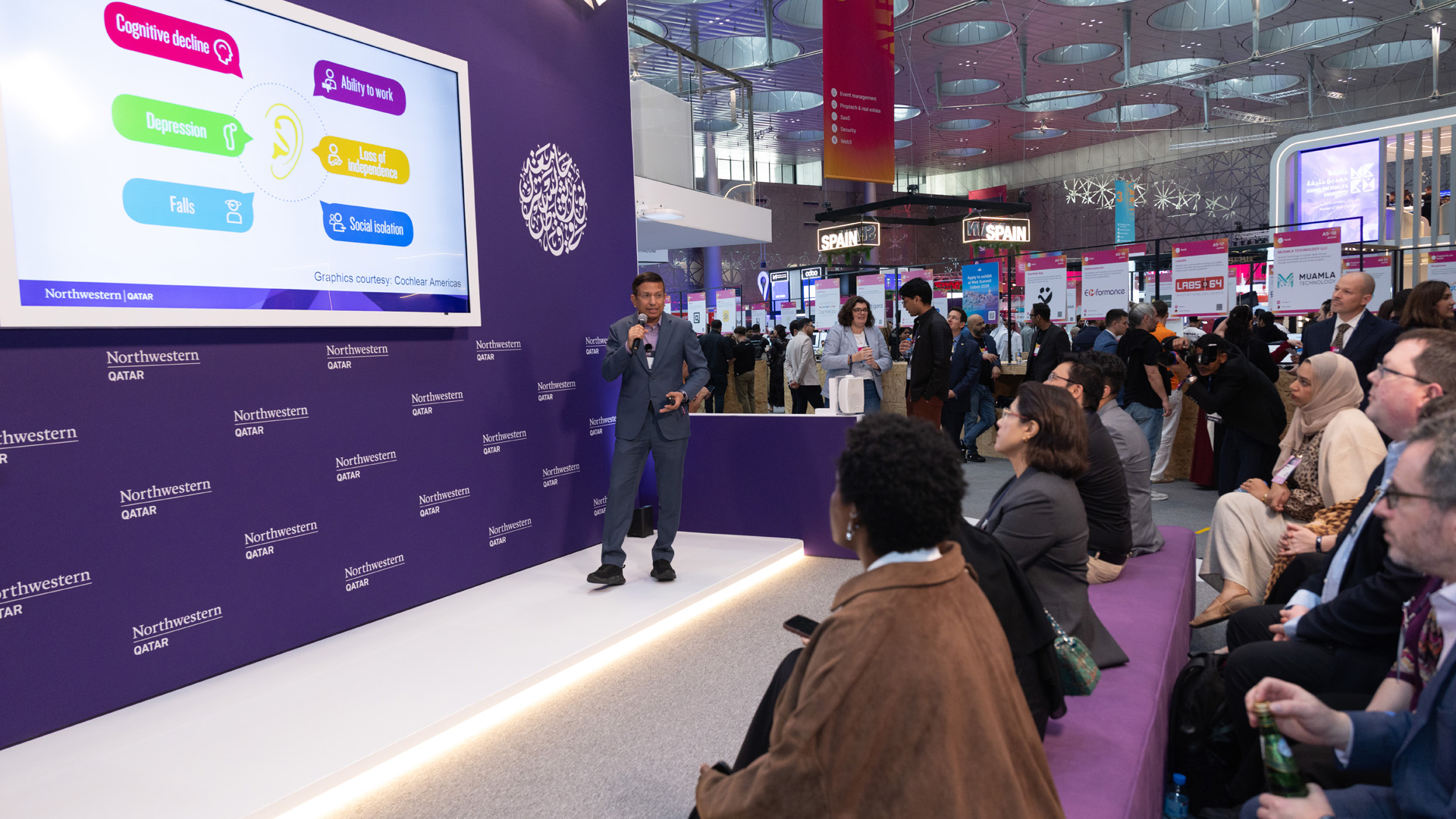
Faculty, students, and researchers from Northwestern University in Qatar and Northwestern University in Evanston took to the stage at Web Summit Qatar 2026 to share cutting-edge scholarship and research as part of the University’s expanded programming at the global technology conference.
Across three days, Northwestern Qatar delivered 29 presentations led by 35 presenters, reflecting the breadth of the University’s academic, research, and professional expertise. The sessions were a central pillar of Northwestern Qatar’s broader presence at the Summit this year, which featured an expanded two-story pavilion designed to foster exchange among academia, industry, policymakers, and the wider public.
“This year’s programming was intentionally designed to deepen and enrich Northwestern Qatar’s presence at Web Summit,” said Nisar Keshvani, assistant dean for communication and public affairs and chair of the University’s Web Summit Committee. “By expanding the number and range of scholarly presentations, we created more entry points for meaningful engagement and ensured that our faculty, students, and researchers could contribute directly to conversations shaping technology, media, and society globally.”
Presenters included faculty members, researchers, students, visiting scholars from Evanston, and industry leaders, offering interdisciplinary perspectives on media, technology, artificial intelligence, communication, and society.
Across three days, Northwestern Qatar delivered 29 presentations led by 35 presenters, reflecting the breadth of the University’s academic, research, and professional expertise. The sessions were a central pillar of Northwestern Qatar’s broader presence at the Summit this year, which featured an expanded two-story pavilion designed to foster exchange among academia, industry, policymakers, and the wider public.
“This year’s programming was intentionally designed to deepen and enrich Northwestern Qatar’s presence at Web Summit,” said Nisar Keshvani, assistant dean for communication and public affairs and chair of the University’s Web Summit Committee. “By expanding the number and range of scholarly presentations, we created more entry points for meaningful engagement and ensured that our faculty, students, and researchers could contribute directly to conversations shaping technology, media, and society globally.”
Presenters included faculty members, researchers, students, visiting scholars from Evanston, and industry leaders, offering interdisciplinary perspectives on media, technology, artificial intelligence, communication, and society.
Several sessions drew on work supported by the Institute for Advanced Study in the Global South (#IAS_NUQ). Faculty and fellows from both #IAS_NUQ and the Artificial Intelligence and Media (AIM) Lab examined issues at the intersection of media, technology, and artificial intelligence, with particular attention to perspectives from the Global South.
Similarly, research from the AIM Lab featured prominently throughout the program, with presentations exploring the implications of AI for journalism, creativity, authorship, and public trust. The Executive Education Program also contributed sessions focused on leadership, communication, and professional practice in rapidly evolving organizational environments.
Students played an active role alongside faculty, presenting research, creative projects, and collaborative work that reflected Northwestern Qatar’s emphasis on experiential learning and public-facing scholarship.
“Web Summit offers a unique platform where academic ideas can be tested, translated, and discussed in real time,” said Professor S. Venus Jin, associate dean for education, founding director of the Artificial Intelligence and Media (AIM) Lab, and vice chair of the Web Summit Committee. “Bringing our scholarship into this space takes the scholarly and creative works produced to the global stage, allowing research to engage directly with industry, policymakers, and the public.”
Together, the presentations demonstrated how Northwestern Qatar’s expanded programming at Web Summit Qatar 2026 positioned scholarship not only as a subject of discussion but as a catalyst for dialogue and connection across disciplines and sectors.
Similarly, research from the AIM Lab featured prominently throughout the program, with presentations exploring the implications of AI for journalism, creativity, authorship, and public trust. The Executive Education Program also contributed sessions focused on leadership, communication, and professional practice in rapidly evolving organizational environments.
Students played an active role alongside faculty, presenting research, creative projects, and collaborative work that reflected Northwestern Qatar’s emphasis on experiential learning and public-facing scholarship.
“Web Summit offers a unique platform where academic ideas can be tested, translated, and discussed in real time,” said Professor S. Venus Jin, associate dean for education, founding director of the Artificial Intelligence and Media (AIM) Lab, and vice chair of the Web Summit Committee. “Bringing our scholarship into this space takes the scholarly and creative works produced to the global stage, allowing research to engage directly with industry, policymakers, and the public.”
Together, the presentations demonstrated how Northwestern Qatar’s expanded programming at Web Summit Qatar 2026 positioned scholarship not only as a subject of discussion but as a catalyst for dialogue and connection across disciplines and sectors.


