Podcast Studio conversations bring research, education, and innovation into dialogue at Web Summit Qatar 2026
February 09, 2026
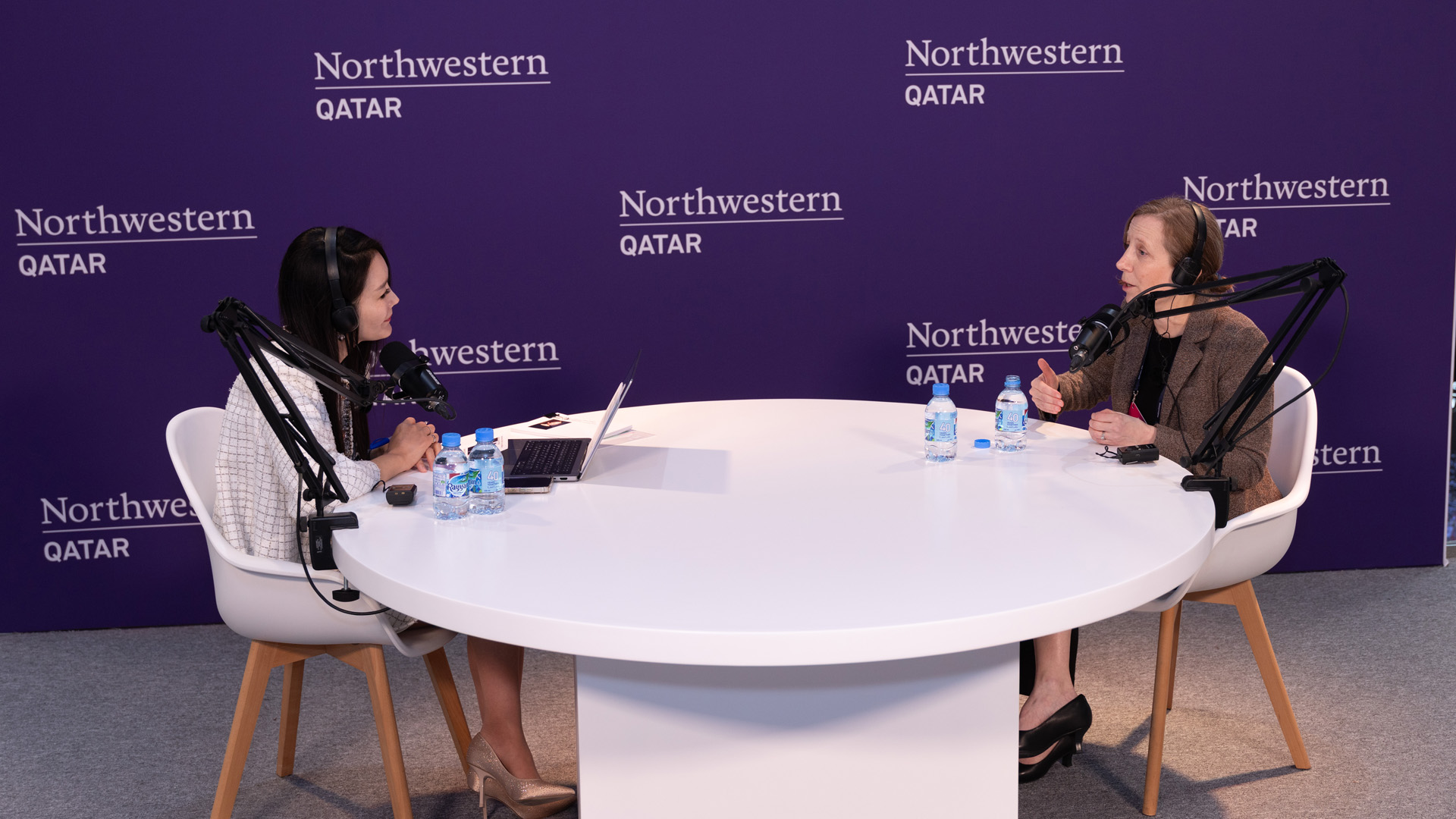
Northwestern University in Qatar’s faculty, staff, and researchers took to the microphones at Web Summit Qatar 2026, engaging diverse global voices in conversations spanning media, technology, and artificial intelligence. Through a robust slate of live and recorded podcast sessions, the University transformed dialogue into a public-facing practice—one that connected academic insight with real-time global conversations unfolding on the Summit floor.
The podcast programming formed a core pillar of Northwestern Qatar’s expanded presence at the Summit, which featured a larger, two-story pavilion designed as a hub for interaction and exchange. Alongside presentation stages and immersive exhibition spaces, the Podcast Studio showcased faculty research, latest thought leadership, student innovation and creativity, highlighting work supported by AURORA grants, the #IAS_NUQ Global Undergraduate Fellowships, and other academic and research initiatives.
Throughout the Summit, the University hosted 28 podcast episodes featuring 29 podcasters, including faculty, visiting scholars, senior administrators, and industry leaders. Recorded live at the pavilion, the sessions were designed for both immediacy and longevity, encouraging on-site engagement while extending their reach through post-event distribution across Northwestern Qatar and partner platforms.
Reflecting on the role of podcasting within the University’s Web Summit presence, Nisar Keshvani, assistant dean for communication and public affairs and chair of the University’s Web Summit Committee, highlighted its power as a platform for connection and exchange. “The podcast studio created a space where ideas could move freely, between research and practice, academia and industry, Qatar and the world,” she noted. “Recording these conversations live allowed us to capture the energy of the Summit while giving our faculty, students, and partners an accessible medium to share their work and engage meaningfully with the questions shaping media and technology.”
The podcast programming formed a core pillar of Northwestern Qatar’s expanded presence at the Summit, which featured a larger, two-story pavilion designed as a hub for interaction and exchange. Alongside presentation stages and immersive exhibition spaces, the Podcast Studio showcased faculty research, latest thought leadership, student innovation and creativity, highlighting work supported by AURORA grants, the #IAS_NUQ Global Undergraduate Fellowships, and other academic and research initiatives.
Throughout the Summit, the University hosted 28 podcast episodes featuring 29 podcasters, including faculty, visiting scholars, senior administrators, and industry leaders. Recorded live at the pavilion, the sessions were designed for both immediacy and longevity, encouraging on-site engagement while extending their reach through post-event distribution across Northwestern Qatar and partner platforms.
Reflecting on the role of podcasting within the University’s Web Summit presence, Nisar Keshvani, assistant dean for communication and public affairs and chair of the University’s Web Summit Committee, highlighted its power as a platform for connection and exchange. “The podcast studio created a space where ideas could move freely, between research and practice, academia and industry, Qatar and the world,” she noted. “Recording these conversations live allowed us to capture the energy of the Summit while giving our faculty, students, and partners an accessible medium to share their work and engage meaningfully with the questions shaping media and technology.”
Several episodes highlighted how institutions are navigating leadership, education, and innovation in an era shaped by rapid technological change. In “Leading an R&D Lab,” S. Venus Jin, professor in residence, associate dean for education, and founding director of the Artificial Intelligence and Media (AIM) Lab, hosted Sumitrajit (Sumit) Dhar, professor and Hugh Knowles Chair in Hearing Sciences at Northwestern University’s School of Communication.
Their conversation examined what it takes to build and sustain high-impact research labs, from cultivating collaborative cultures to mentoring emerging scholars and translating academic discovery into societal benefit. The episode offered a behind-the-scenes look at how vision, leadership, and teamwork shape scientific advancement.
Education’s evolving role in a technology-driven world was another recurring theme. In a special episode produced in collaboration with the World Innovation Summit for Education (WISE), Assistant Dean for Communication and Public Affairs Nisar Keshvani spoke with Dr. Asyia Kazmi, OBE, CEO of WISE, on “Shaping the Future of Education.” The conversation explored how education systems are being reimagined amid profound social, cultural, and technological shifts, examining how institutions are responding to widening gaps between current educational models and the needs of future generations.
Assistant Professor Scheherazade Safla-Gaffoor, who hosted seven podcast episodes during the Summit and teaches podcasting at Northwestern Qatar, described the experience as a natural extension of her classroom work. “This was a rare opportunity to take what we teach about podcasting and public storytelling into a live, real-world setting,” she said. “Hosting these conversations at Web Summit allowed us to model the full process, from editorial framing to live production, while creating space to highlight faculty research and engage directly with industry voices. It was especially valuable for students to see how academic ideas can move into public dialogue in real time.”
The intersection of artificial intelligence and higher education was examined in “Education in the Age of AI,” hosted by Jin and featuring Karen Smilowitz, associate provost for undergraduate education at Northwestern University and professor at Kellogg. Moving beyond anxiety-driven narratives, the episode explored how AI is reshaping teaching, assessment, creativity, and academic integrity, inviting listeners to envision how emerging technologies can enhance human learning and judgment.
The Podcast Studio was part of a three-day program that also featured live presentations and the Media Majlis Museum’s interactive exhibition.
Their conversation examined what it takes to build and sustain high-impact research labs, from cultivating collaborative cultures to mentoring emerging scholars and translating academic discovery into societal benefit. The episode offered a behind-the-scenes look at how vision, leadership, and teamwork shape scientific advancement.
Education’s evolving role in a technology-driven world was another recurring theme. In a special episode produced in collaboration with the World Innovation Summit for Education (WISE), Assistant Dean for Communication and Public Affairs Nisar Keshvani spoke with Dr. Asyia Kazmi, OBE, CEO of WISE, on “Shaping the Future of Education.” The conversation explored how education systems are being reimagined amid profound social, cultural, and technological shifts, examining how institutions are responding to widening gaps between current educational models and the needs of future generations.
Assistant Professor Scheherazade Safla-Gaffoor, who hosted seven podcast episodes during the Summit and teaches podcasting at Northwestern Qatar, described the experience as a natural extension of her classroom work. “This was a rare opportunity to take what we teach about podcasting and public storytelling into a live, real-world setting,” she said. “Hosting these conversations at Web Summit allowed us to model the full process, from editorial framing to live production, while creating space to highlight faculty research and engage directly with industry voices. It was especially valuable for students to see how academic ideas can move into public dialogue in real time.”
The intersection of artificial intelligence and higher education was examined in “Education in the Age of AI,” hosted by Jin and featuring Karen Smilowitz, associate provost for undergraduate education at Northwestern University and professor at Kellogg. Moving beyond anxiety-driven narratives, the episode explored how AI is reshaping teaching, assessment, creativity, and academic integrity, inviting listeners to envision how emerging technologies can enhance human learning and judgment.
The Podcast Studio was part of a three-day program that also featured live presentations and the Media Majlis Museum’s interactive exhibition.


