From Zambian political fabrics to Qatari abaya modernities: Latest in the #IAS_NUQ_Press paper series by Global Undergraduate Fellows
December 16, 2025
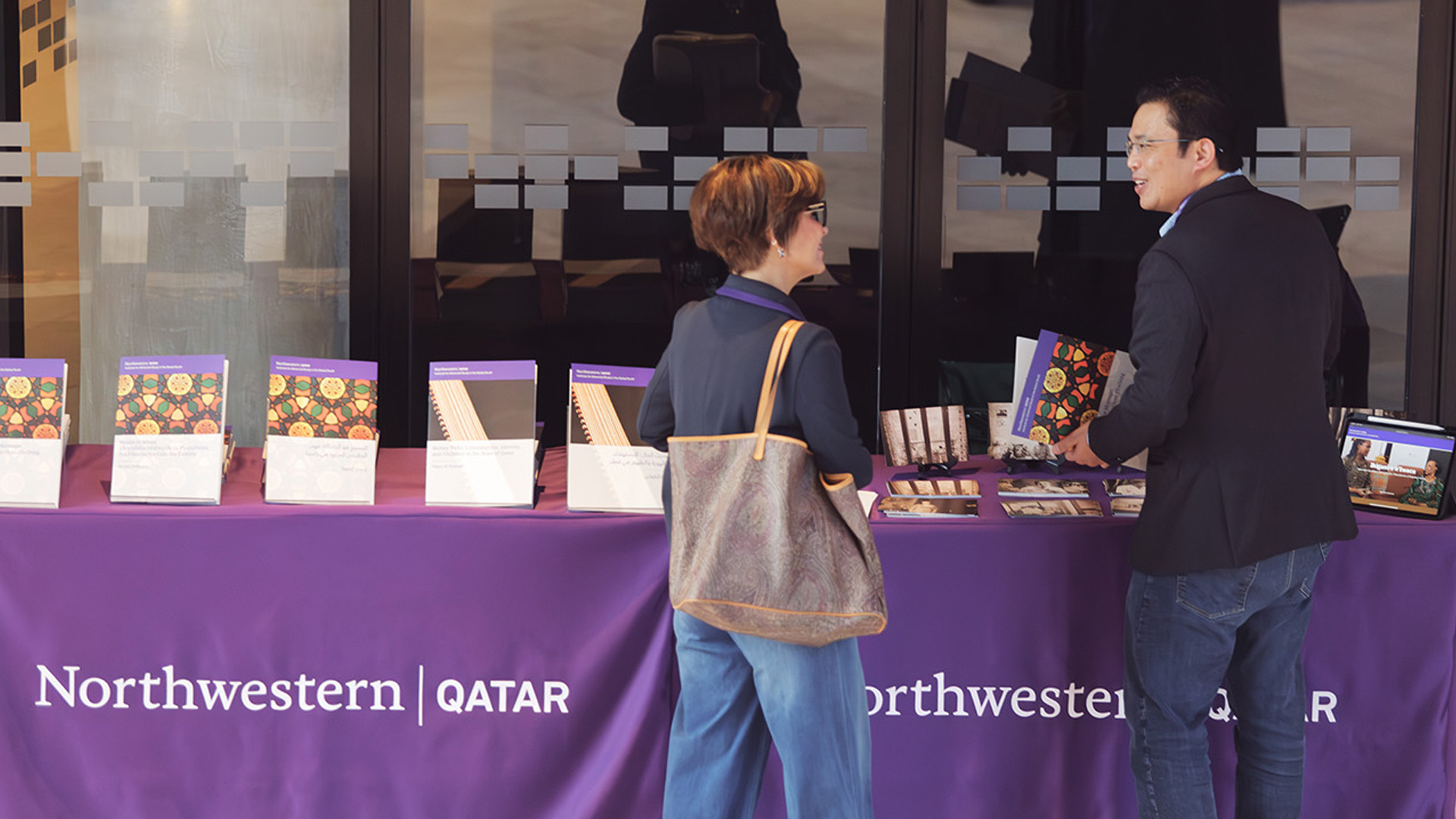
The Institute for Advanced Study in the Global South at Northwestern University in Qatar (#IAS_NUQ) has announced the first set of academic papers authored by its Global Undergraduate Fellows, marking a milestone in its mission to produce and promote evidence-based storytelling focused on the histories, cultures, societies, and media of the Global South.
Published through #IAS_NUQ_Press, the new series features research papers by Global Undergraduate Fellows In’utu Imbuwa, Haya Al Kuwari, and Safae Daoudi. As part of their fellowships, each student conducted original fieldwork and worked closely with #IAS_NUQ faculty and staff mentors to refine their ideas into publication-ready research. Each paper was published in English, Arabic, and the language of the region studied.
“Our Global Undergraduate Fellows embody what evidence-based storytelling can achieve,” said Marwan M. Kraidy, dean and CEO of Northwestern Qatar. “This fellowship gives students the time, mentorship, and intellectual space to turn their questions into rigorous inquiry and their fieldwork into meaningful contributions to knowledge. Watching them transform raw observations into published papers is profoundly inspiring. Their work reminds us that when students engage the world with curiosity and discipline, they produce multilingual and multimodal original scholarship on Qatar and across the region.”
Published through #IAS_NUQ_Press, the new series features research papers by Global Undergraduate Fellows In’utu Imbuwa, Haya Al Kuwari, and Safae Daoudi. As part of their fellowships, each student conducted original fieldwork and worked closely with #IAS_NUQ faculty and staff mentors to refine their ideas into publication-ready research. Each paper was published in English, Arabic, and the language of the region studied.
“Our Global Undergraduate Fellows embody what evidence-based storytelling can achieve,” said Marwan M. Kraidy, dean and CEO of Northwestern Qatar. “This fellowship gives students the time, mentorship, and intellectual space to turn their questions into rigorous inquiry and their fieldwork into meaningful contributions to knowledge. Watching them transform raw observations into published papers is profoundly inspiring. Their work reminds us that when students engage the world with curiosity and discipline, they produce multilingual and multimodal original scholarship on Qatar and across the region.”
“This fellowship gives students the time, mentorship, and intellectual space to turn their questions into rigorous inquiry and their fieldwork into meaningful contributions to knowledge. Watching them transform raw observations into published papers is profoundly inspiring. Their work reminds us that when students engage the world with curiosity and discipline, they produce multilingual and multimodal original scholarship on Qatar and across the region”
- Marwan M. Kraidy, CEO of Northwestern Qatar and Clovis Bergère, director of the Institute, in the co-authored introduction
The first paper in the series, “The Fabric is the Message: Understanding Partisan Clothing in Zambia,” by In’utu Imbuwa ’25, looks at the significance of partisan clothing in nonverbal political messaging and its role in shaping voting behavior and electoral outcomes. Imbuwa examines how chitenge, a vibrant, sarong-like fabric frequently decorated with political symbols, slogans, or images of candidates, contributes to the mobilization of political party loyalists and promotes "watermelon politics," a term introduced by Mats Utas in Sierra Leone to describe individuals who publicly support one political party while secretly aligning with another.
Imbuwa’s study draws on interviews with campaign staff and voters, as well as an examination of artifacts and election materials, to explore the cultural and symbolic importance of partisan clothing. Written originally in English, this paper is also available in Arabic and Bemba on the #IAS_NUQ website.
The second paper, “Money Talks: Consumption, Identity, and Visibility in Qatar,” by Haya Al Kuwari ’24, is part of an ethnographic study conducted by Haya Al Kuwari ’24, in which she explored the cultural significance of abayas as central to current reimaginations of identity, place, and modernity in the Gulf. The paper studies the cultural and fashion evolution of abayas over the years, spotlighting fashion exhibitions and pop-up events across Doha. The paper, available in both English and Arabic, offers a rich ethnography of the changing fashion scene in Doha through interviews with Qatar-based designers and their clients.
The third paper in the series, “Finding Spirituality in Foreign Lands: The Ziyarah to Fes and Its Implications for Senegal–Morocco Diplomatic Relations,” authored by Safae Daoudi ’24, spotlights the role of religion in Morocco’s soft power aspirations in West Africa. Through ethnographic vignettes, interviews, and historical analysis, the paper looks at the changing nature of religious diplomacy in Africa and how Morocco mobilizes its religious capital to consolidate influence in West Africa. Daoudi’s paper is available online in English, Arabic, and French.
Imbuwa’s study draws on interviews with campaign staff and voters, as well as an examination of artifacts and election materials, to explore the cultural and symbolic importance of partisan clothing. Written originally in English, this paper is also available in Arabic and Bemba on the #IAS_NUQ website.
The second paper, “Money Talks: Consumption, Identity, and Visibility in Qatar,” by Haya Al Kuwari ’24, is part of an ethnographic study conducted by Haya Al Kuwari ’24, in which she explored the cultural significance of abayas as central to current reimaginations of identity, place, and modernity in the Gulf. The paper studies the cultural and fashion evolution of abayas over the years, spotlighting fashion exhibitions and pop-up events across Doha. The paper, available in both English and Arabic, offers a rich ethnography of the changing fashion scene in Doha through interviews with Qatar-based designers and their clients.
The third paper in the series, “Finding Spirituality in Foreign Lands: The Ziyarah to Fes and Its Implications for Senegal–Morocco Diplomatic Relations,” authored by Safae Daoudi ’24, spotlights the role of religion in Morocco’s soft power aspirations in West Africa. Through ethnographic vignettes, interviews, and historical analysis, the paper looks at the changing nature of religious diplomacy in Africa and how Morocco mobilizes its religious capital to consolidate influence in West Africa. Daoudi’s paper is available online in English, Arabic, and French.
“The three inaugural papers in the #IAS_NUQ_Press Paper series exemplify what #IAS_NUQ is all about”
- Clovis Bergère, director of #IAS_NUQ.
“The three inaugural papers in the #IAS_NUQ_Press Paper series exemplify what #IAS_NUQ is all about,” said Clovis Bergère, director of #IAS_NUQ. “Penned by our Global Undergraduate Fellows, they explore topics ranging from abaya fashion and imaginations of modernities in Qatar, to Moroccan soft power in West Africa, and partisan clothing in Zambia. Published in multiple languages, these papers are grounded in the lived experiences of the Global South and make important scholarly contributions to our understanding of the world.”
The Global Undergraduate Fellowship program supports students in creating original contributions to knowledge through evidence-based storytelling grounded in rigorous research methods. The fellowship culminates in the publication of the fellow’s work through #IAS_NUQ_Press and a presentation to the Northwestern Qatar community.
Fellows have also received support to present their research at conferences and scholarly gatherings around the world, including the annual conferences of the International Communication Association and the Middle East Studies Association, and the International Association for Media and Communication Research, among others.
“#IAS_NUQ Global Undergraduate Fellows are central to our mission to advance knowledge on the Global South. These students bring in new perspectives, ideas, and approaches to evidence-based storytelling that address enduring questions and pressing issues,” said Bergère.
For more information on #IAS_NUQ_Press or to download the papers, visit the #IAS_NUQ website at https://www.qatar.northwestern.edu/research/ias_nuq/
The Global Undergraduate Fellowship program supports students in creating original contributions to knowledge through evidence-based storytelling grounded in rigorous research methods. The fellowship culminates in the publication of the fellow’s work through #IAS_NUQ_Press and a presentation to the Northwestern Qatar community.
Fellows have also received support to present their research at conferences and scholarly gatherings around the world, including the annual conferences of the International Communication Association and the Middle East Studies Association, and the International Association for Media and Communication Research, among others.
“#IAS_NUQ Global Undergraduate Fellows are central to our mission to advance knowledge on the Global South. These students bring in new perspectives, ideas, and approaches to evidence-based storytelling that address enduring questions and pressing issues,” said Bergère.
For more information on #IAS_NUQ_Press or to download the papers, visit the #IAS_NUQ website at https://www.qatar.northwestern.edu/research/ias_nuq/


